Choosing the right CRM Consulting Company can determine whether your CRM becomes a useful business system or another application your teams struggle to use.
CRM platforms like Salesforce , Zoho and more, have become far more capable, bringing automation, integrations, analytics, AI, and connected data into what was once primarily a system for managing customer and sales information.
With that expanded capability comes more decisions about what your business actually needs, what should be integrated, what should be automated, and where customization or AI makes sense.
The right consulting partner should help you make those decisions based on your business, not simply implement whatever features a platform offers.
So, in this blog , we bring to you the seven critical questions that businesses must ask before hiring a CRM consulting partner. Here they come:
Q1. How will you understand our business before recommending a solution?
This is probably the first question worth asking, especially if a CRM consulting company is eager to jump straight into a CRM demo.
Before discussing dashboards, automation, or AI, a good consultant should understand how your business actually works. That includes your sales and service processes, customer journeys, existing applications, data, reporting needs, user roles, and current pain points.
This matters even more if you’re choosing between Salesforce, Zoho, HubSpot, or another platform. The best CRM isn’t necessarily the one with the varied features, instead it’s the one that fits your processes, users, budget, integrations, and growth plans.
If you already have a CRM, the assessment should also cover its configuration, customizations, automation, integrations, data quality, and technical debt.
So, ask for the discovery approach and what it will produce. A clear assessment and roadmap tell you more than a quick product demonstration.
2. How do you decide which CRM capabilities we actually need?
Modern CRM platforms can do far more than most businesses need. So, IT consulting service isn’t just about knowing what a platform can do. It is knowing what your business actually needs it to do.
Sometimes, a feature may look impressive in a demo without solving a real problem, and the same applies to AI too.
Salesforce’s Agentforce can support AI agents that use business data and take actions across workflows, while Zoho CRM’s Zia Agents can be configured with specific purposes, knowledge, tools, and connections.
The important question isn’t whether a partner can implement these capabilities. It is whether they can identify where they make business sense.
Ask how the partner decides:
- What should be implemented now
- What can wait
- What should be automated
- Where AI or agents add measurable value
- Which capabilities should remain standard
- Where customization is justified
3. How will you handle our data and integrations?
Here’s something worth remembering when evaluating a CRM partner,that your CRM is rarely the only system holding customer data.
Your vital Information may already sit across ERP systems, marketing platforms, ecommerce applications, support tools, spreadsheets, and legacy databases.
So when a consulting company says they can integrate all your integrations, don’t get satisfied there. Ask them to explain how they would approach the data and integration architecture for your environment.
Find out:
- Which system will be the source of truth
- What data needs to move into the CRM
- What should remain in external systems
- How duplicates and incomplete data will be handled
- Which integrations need real-time data
- How APIs or middleware will be used
- How integrations will be monitored after deployment
This becomes even more important with modern data platforms. Salesforce Data 360, for example, can bring together data from different sources and support unified customer profiles, identity resolution, and access to external data.
But the right architecture depends on your data, use cases, governance, and existing systems.
- What is your approach to AI and agentic CRM?
Once AI enters the CRM conversation, it is tempting to assume that every repetitive process should become an AI use case. It shouldn’t.
For Agentforce or similar agentic capabilities, a CRM consulting partner should consider data readiness, permissions, knowledge, business rules, testing, human oversight, and monitoring.
So ask:
“How do you determine whether an AI agent is appropriate for a particular process?”
A good partner should be able to identify where an agent can handle work, assist employees, or improve customer interactions and where conventional automation is the better choice.
Remember, not every repetitive process needs an AI agent.
5. How do you balance configuration, customization, and modernization?
This question becomes particularly important when you’re working with an existing CRM.
Over time, organizations accumulate custom fields, workflows, code, integrations, third-party applications, and processes that may be difficult to maintain. Simply carrying all of that into a new implementation can recreate the same problems.
A good CRM Consulting Company should be able to explain when it would:
- Use standard platform capabilities
- Configure existing functionality
- Introduce automation
- Build custom functionality
- Replace an outdated component
- Modernize an existing architecture
At Synexc, we believe the question isn’t if we can customize this but the important one if we should customize this.
The objective is a CRM environment that is maintainable, scalable, and easier to evolve.
So when a partner recommends custom development, ask them to explain why it is necessary.
6. How will you measure the success of the CRM implementation?
Ideally, a good IT Consulting partner should be able to connect the technical implementation to measurable business outcomes.
Before implementation begins, your consulting partner should help define what success actually means for your organization.
Depending on the project, that might include:
- Higher CRM adoption
- Less manual work
- Faster sales or service processes
- Better data quality
- Improved customer response times
- Better pipeline visibility
- Greater productivity
- Lower operational costs
- Measurable ROI from automation or AI
This is especially important when implementing capabilities such as Data 360 or Agentforce. Connecting data or deploying an agent is not the end goal. The value comes from what the business can do better because of it.
7. What happens after the CRM goes live?
And finally, ask the question that often gets pushed to the end:
“What happens after you hand the system over to us?”
Because your CRM isn’t going to sit still.
Users will need changes. Business processes will evolve. New applications will need integration. Platform capabilities will continue to develop, and automation and AI may need ongoing refinement.
Ask what the consulting company provides after go-live. That may include:
- CRM administration and support
- Performance and data-quality monitoring
- Automation optimization
- Integration maintenance
- AI or agent monitoring
- User training
- Release management
- Security and governance reviews
- Ongoing roadmap planning
This is where a consulting partner can become more than an implementation vendor.
At Synexc, we see ongoing CRM support as part of helping the system continue to serve the business as it changes.
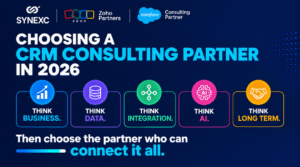
What Makes a CRM Consulting Company the Right Fit?
By now, you probably have a good idea of what to ask. But pay attention to how the consulting company answers, too.
- Observe the questions questions before recommending a platform
- Can they explain why one approach is better than another?
- Are they willing to challenge unnecessary customization?
- Do they talk about data, adoption, integrations, and business outcomes too?
Those answers can tell you more than a list of certifications or project counts.
Whether you’re evaluating Salesforce, Zoho, HubSpot, or another CRM platform, the principle remains the same: the technology should support the business, not the other way around.
That’s the approach we take at Synexc. As a Salesforce Consulting Partner and Zoho Partner, we work across CRM ecosystems and focus on finding the right fit for the business rather than forcing every requirement into the same solution.
If you’re evaluating a CRM, modernizing an existing environment, planning integrations, or trying to understand where automation and AI genuinely fit,contact Synexc for a discussion !!
Frequently Asked Questions
Q1: How do I know if a CRM consulting company understands our business, not just the CRM platform?
Look at the questions they ask before recommending a solution. A capable consultant should understand your business processes, goals, users, and technology environment, then connect CRM capabilities to those needs rather than simply demonstrating platform features.
Q2: How much technical expertise should a CRM consulting company have?
Well, a good IT consulting firm must have expertise across varied tools and technologies. Depending on your requirements, look for expertise in APIs, integrations, data architecture, automation, security, custom development, and legacy systems. This becomes critical when your CRM needs to work with the rest of your technology ecosystem.
Q3: What should I ask a CRM consultant about AI?
Ask how they identify practical AI use cases, what data those solutions require, how AI fits into your workflows, and how its impact will be measured. A good CRM consulting company should connect AI capabilities to a specific business outcome, not simply add AI to the proposal.
Q4: Can a newer CRM consulting company be the right choice?
Absolutely. Years in business are not the only measure of consulting capability. A newer CRM consulting company can bring current platform expertise, fresh thinking, skilled specialists, and a willingness to approach problems differently.
Look at the team’s technical depth, problem-solving approach, curiosity, and ability to work with modern CRM, AI, automation, integrations, and data architecture. These can matter as much as years of experience.
Q5: How can I compare CRM consulting companies beyond their quoted price?
A lower quote isn’t necessarily better if critical work has been excluded. Compare more than the headline cost. Look at these aspects too:
- what is included
- who will deliver the work
- the technical approach
- integration and migration scope
- post-launch support, and
- potential additional costs.