Thirty years of Zoho, a packed day at its Chennai headquarters, and a lot of conversation around what comes next for AI at work. That was the setting for Zoholics India 2026.
But if you look past the anniversary celebrations and the long list of product sessions, there was a much clearer story running through the event.
Zoho is changing the way its software is meant to be used and the headline announcements made that pretty obvious
There was plenty happening throughout the day, from product deep dives and AI discussions to customer and partner conversations. The event also brought a broader discussion around AI, innovation and building technology from India.
So, what actually stood out at Zoholics India 2026?
Let’s look at the announcements and the key takeaways that are likely to matter most for businesses using Zoho, planning a Zoho CRM implementation, or looking at what comes next for AI-powered business applications.
1. Zia Chat changes how users interact with Zoho
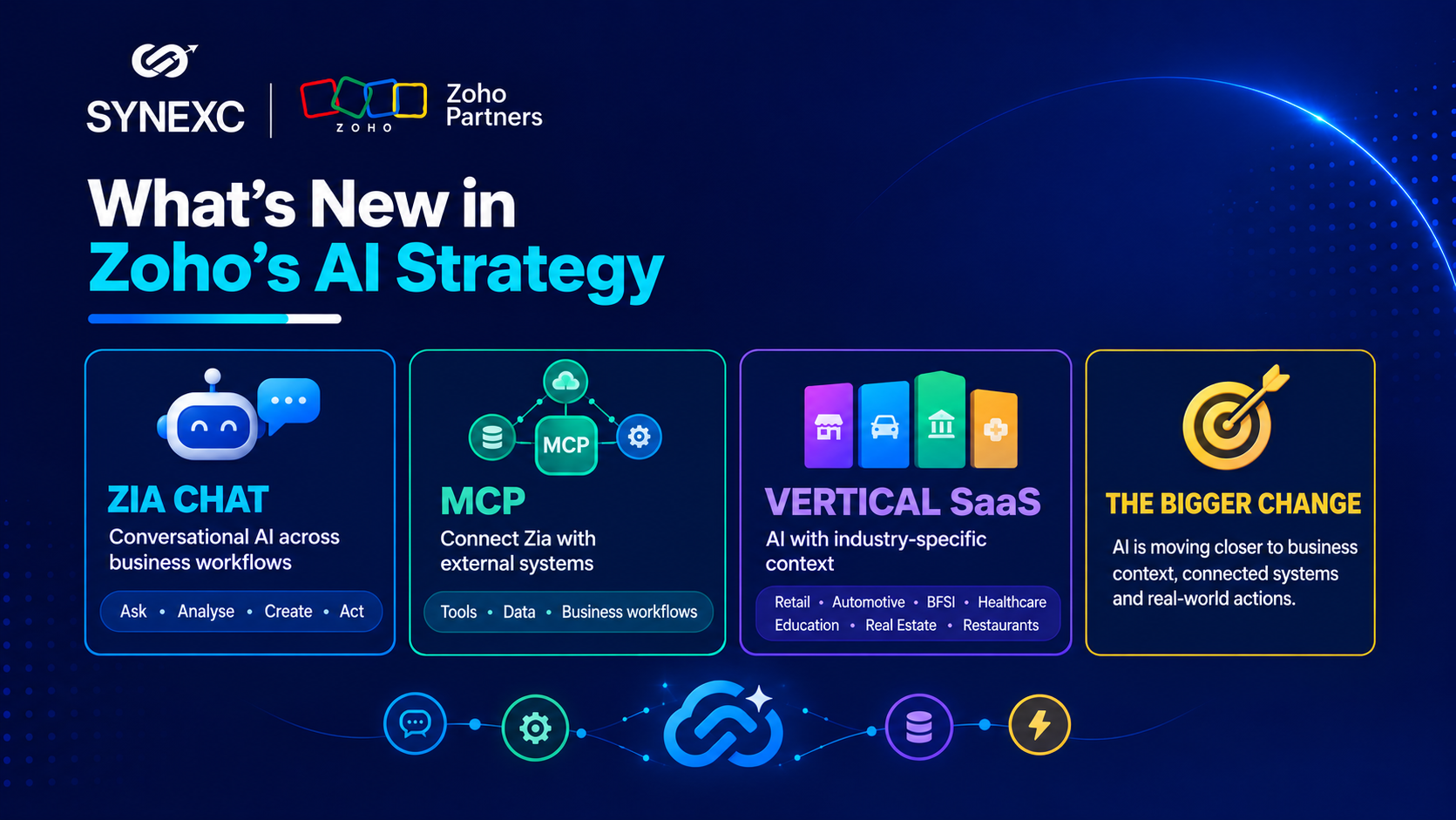
The biggest product announcement was Zia Chat, a conversational AI interface designed to bring information, context and actions from across Zoho applications into one place.
The important part isn’t simply that users can ask questions in natural language.
Zia Chat can
- work across applications
- understand relationships between business data,
- create reports and presentations
- draft emails, analyse information
- initiate tasks.
Zia Agents can also handle multi-step work within the permissions given to them.
Instead of moving between CRM, Desk, Books and other applications to find information or complete related tasks, users can interact with that business context through a single interface.
There is also a strong focus on control. Zia Chat respects existing permissions, administrators can control access, and Zoho says customer business data is not used to train AI models.
Businesses can also use supported external models through BYOK or Zoho-hosted options depending on their requirements.
For companies going through a Zoho CRM Implementation, this puts more importance on the fundamentals behind the setup. Data quality, permissions and workflows directly affect what AI can understand and do.
2. MCP takes Zia beyond Zoho
MCP is another important part of the announcement because it extends Zia’s reach beyond Zoho’s own applications.
Through MCP integrations, external business systems can expose information and capabilities that Zia can work with. That changes the role of integration from simply moving data between applications to giving AI access to a wider set of business tools and context.
For businesses, this could make a Zoho Integration Service part of a much broader architecture. CRM, finance, support and custom business systems don’t necessarily have to operate as isolated applications.
It also creates opportunities for Custom Zoho App Development. A custom application can be designed with the wider connected environment in mind rather than functioning as a standalone tool.
This is where MCP becomes strategically important to Zoho’s AI direction. Zia isn’t limited to what already exists inside the Zoho suite.
3. Zoho is going deeper into vertical SaaS
The other major announcement was Zoho’s move into vertical SaaS.
Zoho announced seven industry-specific applications covering:
- Retail
- Automotive
- BFSI
- Healthcare
- Education
- Real estate
- Restaurants
The products are designed around the workflows and requirements of these specific industries rather than simply adapting a general-purpose business application to a particular sector.
The initial portfolio includes products such as Zoho RetailIQ for retail, Zoho AutoDMS for automotive dealerships, Zoho LOS for loan origination and Zoho MedScribe for healthcare documentation. Zoho also announced offerings for education, real estate and restaurants.
This is a significant expansion of the Zoho platform.
Zoho has traditionally built horizontal applications that serve businesses across industries. With vertical SaaS, the company is adding another layer: applications designed around the specific processes, requirements and regulatory considerations of individual industries.
4. Zoho’s AI strategy is about context, not just bigger models
One of the strongest ideas running through the keynote was Sridhar Vembu’s vision of “ubiquitous intelligence,” described through the phrase “UI is the new AI.”
Here, UI does not mean user interface. It refers to intelligence being present across the software people already use rather than making employees open a separate AI tool whenever they need assistance.
That philosophy ties the announcements together without reducing them to a single chatbot story.
Zoho’s approach puts emphasis on the combination of enterprise data, business applications, context, permissions and actions. Vembu has also spoken about AI models becoming increasingly commoditised, with data, privacy, governance and compute efficiency becoming more important considerations.
In practical terms, the value isn’t just in having an AI model inside Zoho, it’s giving that AI enough relevant business context to produce useful results and act within the boundaries of the organisation.
What the Zoholics India 2026 announcements mean for Zoho users
Taken together, the announcements point to a broader change in how Zoho is being positioned.
Zia Chat gives users a new way to interact with their business applications. MCP extends that interaction into external systems. Vertical SaaS gives Zoho deeper industry context, while the existing suite provides the applications and business data underneath it.
For businesses, that makes the quality of the underlying Zoho setup increasingly important.
That is also where Zoho Implementation Service and Custom Zoho App Development start to redefine AI strategy. The goal is not simply to add AI to an existing setup, but to create an environment where the applications, data and workflows are ready to work with it.
The Biggest Takeaway from Zoholics India 2026
If there was one clear direction from Zoholics India 2026, it was this: Zoho is building toward a more connected business platform where AI sits much closer to the applications, data and workflows businesses already depend on.
Zia Chat, MCP and vertical SaaS are different pieces of that direction, but they fit together.
For businesses already using Zoho, or considering a new implementation, the interesting question now is less about which individual feature to adopt and more about how the whole Zoho setup should be designed to take advantage of what is coming next.
Planning your next Zoho setup?
At Synexc, we work across Zoho implementation, integrations, automation and custom Zoho app development, helping businesses connect their CRM, applications and workflows into a setup that can grow with them.
If Zoholics India 2026 has you rethinking what your Zoho environment should look like next, let’s talk about the architecture behind it. Lets connect!
Frequently Asked Questions
Q1: . Will Zia Chat work with applications outside Zoho?
Yes. Zoho has announced MCP-based integrations that allow Zia Chat to connect with external business systems. This extends Zia’s reach beyond information and capabilities available within Zoho’s own applications.
Q2: Can Zia Chat actually take actions, or does it only answer questions?
Zia Chat can do more than answer questions. It can analyse information, create reports and presentations, draft emails, create tasks and support actions across connected Zoho applications. Zia Agents are designed for multi-step workflows, with permissions and controls determining what the AI is allowed to do.
Q3: What could MCP change about Zoho integrations?
MCP could shift integrations from simply synchronising data between applications toward allowing AI to interact with tools and information across those applications. That could make integration architecture, permissions and custom applications more important as businesses adopt AI-driven workflows.
Q4: Will businesses trust AI to make changes across their CRM and other business systems?
That will largely come down to control and governance. Businesses can decide what Zia can access and what actions require permission or confirmation. For sensitive processes such as updating customer records, changing deal stages or triggering business workflows, organisations will still need clear rules around approvals, access and human oversight.