There’s no shortage of AI agents right now.
Every other tool claims to automate something, improve productivity, or handle workflows. And to be fair, many of them do, at least in parts.
The problem is not availability anymore. It’s figuring out which of these are actually being used in real business scenarios and where they fit once you move beyond basic use.
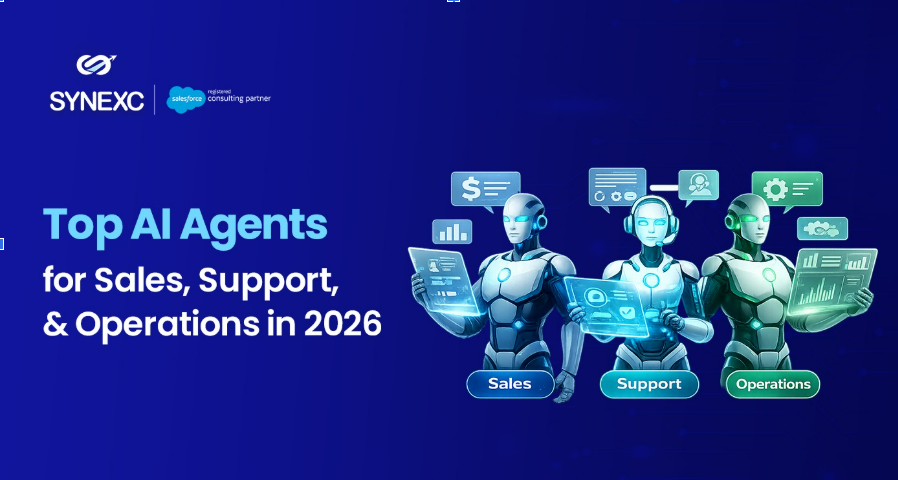
So in this blog, we have curated the top AI agents that are already being used across sales, support, and operations and how they tend to show up in day-to-day work.
What Defines the Best AI Agents in Real Business Environments?
The difference between an AI feature and a production-ready AI agent becomes clear once these systems are deployed inside actual workflows.
The most effective agents operate on structured business data, which allows them to understand context without requiring repeated inputs.
- They remain involved across multi-step processes such as deal progression, case resolution, and workflow automation, instead of resetting after each interaction.
- They are also able to trigger or support actions within systems, whether that involves updating CRM records, routing support cases, or moving data across tools.
In Salesforce CRM implementation services, this distinction shows up early. Agents that require heavy process redesign tend to struggle with adoption, while those that align with existing workflows become part of how teams operate on a daily basis.
This is why integration depth, workflow alignment, and data grounding are now more important than standalone AI capability.
Below are the best AI agents that are actively being used in 2026 and are revolutionizing work across sales, support, and operations.
Best AI Agents for Sales in 2026
-
Agentforce
Built by Salesforce, Agentforce is not something that sits outside your sales process and assists from a distance. It works directly within Salesforce, which is where most sales teams are already managing their pipelines, tracking interactions, and trying to keep data updated.
That positioning changes how it’s actually used. Since it has access to live pipeline data, customer history, and activity logs, it does not need to be constantly fed context. It works with what is already there, which is what makes it more relevant in day-to-day sales execution.
For organizations already investing in Salesforce CRM implementation services or CRM optimization, this is where Agentforce starts to feel less like an add-on and more like part of the system itself.
-
ChatGPT
Developed by OpenAI, ChatGPT is still one of the most commonly used tools by sales teams, but its role is quite different from CRM-based agents.
It tends to sit at the beginning of the workflow.
- Sales reps use it to draft outreach, prepare for meetings, think through responses, or structure ideas before anything gets recorded in the system.
- It is quick, flexible, and easy to use, which is why it has stayed relevant even as more specialised agents have come in.
- At the same time, it does not replace what happens inside CRM.
Most teams end up using it alongside tools like Agentforce rather than instead of them. It helps get things started faster, while system-level agents take over once the work becomes part of the pipeline.
-
Microsoft Copilot
Microsoft Copilot, developed by Microsoft, sits in a slightly different place compared to the other two.
It operates within the communication layer, across Outlook, Teams, and other Microsoft tools where a large portion of sales activity actually happens before it is logged anywhere.
What Copilot does well is keep that context from getting lost.
- It summarizes meetings, tracks what was discussed, and helps structure follow-ups so that the transition from conversation to CRM is smoother.
In organizations that rely heavily on Microsoft’s ecosystem, this becomes part of the natural workflow without requiring any major adjustment.
Best AI Agents for Customer Support in 2026
-
Agentforce
In support environments too, Agentforce is hugely popular but works differently from how it shows up in sales, but the underlying advantage remains the same.
It operates within Salesforce, which means it has access to past interactions, case history, and all the context that usually takes time to piece together.
Anyone who has worked in customer support knows that a large part of the effort goes into understanding the issue before actually resolving it. That’s where this becomes useful. Instead of starting from scratch each time, the agent works with the existing case data and helps move the resolution forward.
Over time, this reduces repetition and improves consistency. For teams working on Salesforce Service Cloud implementation or customer experience improvements, this is often where AI starts to feel practical rather than experimental.
-
Zendesk AI
Zendesk AI comes from Zendesk, and it fits naturally into environments where ticketing systems are already well established.
- Its strength is not in doing something completely new but in making existing support processes more manageable.
- It helps with routing tickets, categorizing issues, and generating responses in a way that keeps things consistent, especially when volumes are high.
For teams dealing with large-scale customer support operations, this kind of structure is what keeps the system from becoming chaotic.
-
Intercom Fin
Intercom Fin, developed by Intercom, is more focused on the front line of customer interaction.
- It handles incoming queries, resolves straightforward issues, and reduces the number of cases that need to be escalated to human agents.
- In many setups, it becomes the first point of contact, especially for repetitive or high-frequency queries.
This has a direct impact on support teams. Instead of being overloaded with basic requests, they can spend more time on complex issues that actually need attention. In fast-moving environments, that shift makes a noticeable difference.
Best AI Agents for Operations and Workflow Automation in 2026
-
Zapier AI
Zapier AI builds on the automation platform created by Zapier, which is already widely used to connect different applications.
With AI added into the mix, these workflows become less rigid. Instead of following fixed rules, they can adjust based on inputs and conditions, which is closer to how real operations actually behave.
Most of this work happens in the background. Data moves between systems, tasks get triggered, and processes continue without needing constant oversight. It is not always visible, but it plays a key role in keeping operations running smoothly across multiple tools.
-
OpenAI Operator
OpenAI Operator is part of OpenAI’s broader push toward agents that can do more than respond.
Unlike traditional tools that stay within one system, Operator is designed to move across applications and handle tasks that involve multiple steps. It can interact with different tools, carry out actions, and move workflows forward without needing constant direction.
It is still evolving, but the direction is clear. This is closer to how operational work actually happens, where tasks rarely stay within one platform.
-
SAP Joule
SAP Joule, developed by SAP, is built for environments where processes are already structured and often complex.
It supports workflows across finance, procurement, and supply chain by helping users navigate systems, retrieve information, and complete tasks more efficiently. These are not flexible environments, so even small improvements in how work gets done can have a noticeable impact.
Rather than changing the process, Joule helps teams move through it with less effort, which is often what matters most in enterprise operations.
Closing Thoughts
AI agents are now shaping how sales, support, and operations function within business systems.
The organizations seeing consistent results are the ones that have integrated these agents into CRM platforms, support environments, and operational workflows where work already happens, rather than treating them as separate tools.
For teams working within platforms like Salesforce, the focus is increasingly on how these agents are positioned within existing processes so that they support execution and scale effectively.
If you are already exploring where AI agents start to deliver measurable value in a way that fits naturally into how your business operates, trusted Salesforce CRM implementation consultants like Synexc can be your go-to partner. Connect now!