You’ve probably heard the phrase floating around lately, “SaaS-pocalypse.”
Some tech leaders are questioning whether traditional SaaS products will survive when autonomous AI agents can do the work humans once logged in to do. It’s a dramatic term, yes. But underneath it sits a real shift.
The interesting part is that SaaS is not collapsing, but what’s collapsing is the old way we implemented it.
And nowhere is this more visible than in CRM.
Traditional CRM implementation, as we’ve known it for two decades, is quietly becoming irrelevant in the age of autonomous agents.
Let’s talk about why.
What Traditional CRM Implementation Looked Like And Why It’s Showing Its Age
For the better part of two decades, CRM programs were built around a central assumption that the value comes from consolidation and control.
The strategic playbook was clear. Consolidate customer data into a single system of record, configure processes with precision, enforce discipline through structured workflows, and measure adoption as a proxy for success.
From a consulting perspective, implementation priorities typically revolved around:
- Comprehensive data migration into Salesforce
- Detailed object modeling aligned to business processes
- Rule-based workflow automation
- User training to ensure accurate and timely data entry
This model was rational. It reflected a world where humans were the primary operators and decision-makers and where CRM served as the authoritative repository of customer intelligence.
But the operating environment has changed.
Autonomous Agents Are Changing the Operating Model
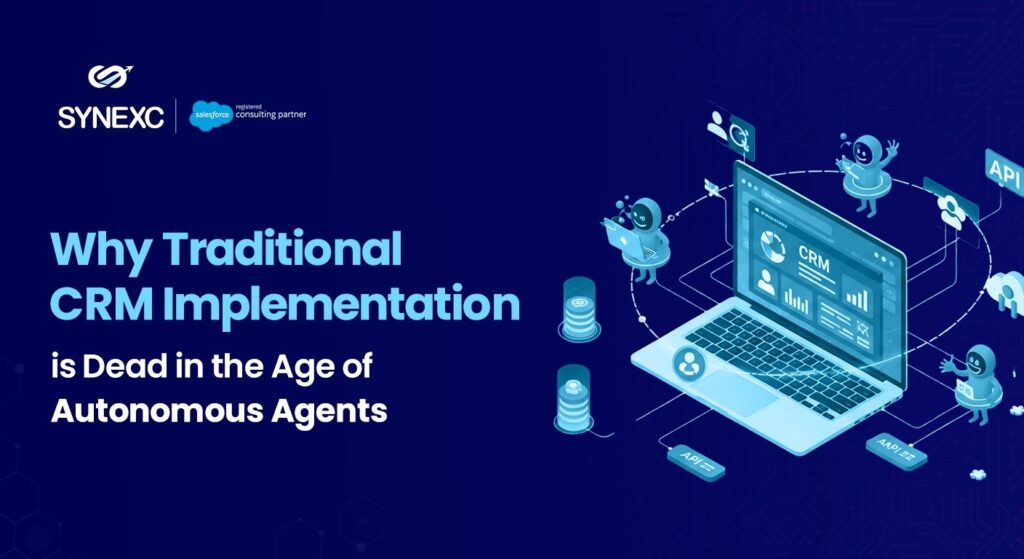
Autonomous agents are not just assisting users. Increasingly, they are executing tasks, prioritizing actions, and maintaining data without manual intervention.
This is not speculative. Surveys show that more than 60 percent of organizations have already embedded AI capabilities into their CRM environments, whether through predictive scoring, automated record updates, or intelligent routing. Adoption is no longer experimental; it’s operational.
When AI begins handling parts of execution, three structural assumptions behind traditional implementation start to weaken:
1. Full data centralization becomes less critical.
Integration layers and APIs allow agents to retrieve and act on distributed data without migrating everything into one environment.
2. Static workflow design loses flexibility.
Rule trees struggle to match context-aware systems that adapt based on patterns and signals.
3. Manual data maintenance is no longer the backbone of system accuracy.
Meeting summaries, activity capture, and next-step suggestions are increasingly automated.
This changes the role of CRM from the primary decision engine to part of a broader intelligence ecosystem.
Where Traditional Salesforce CRM Implementation Services Fall Behind
Many Salesforce CRM implementation service engagements still focus heavily on configuration depth and migration completeness. Those elements remain important. But they are no longer sufficient.
What we see in practice is a growing gap between how CRM is implemented and how it is actually used in AI-enabled environments.
The pressure points tend to surface in subtle ways:
- Large migration projects that deliver structural completeness but limited strategic agility
- Automation frameworks that are technically correct but difficult to evolve
- Governance models built for manual updates, not machine-generated actions
- Implementation timelines that treat go-live as a finish line rather than the start of iterative intelligence tuning
None of this reflects platform weakness. It reflects an implementation mindset that has not fully adjusted.
A modern Salesforce consultant cannot limit their thinking to object design and workflow configuration.
A forward-looking Salesforce consulting firm must evaluate how Salesforce interacts with autonomous processes, external systems, and evolving data strategies.
What Leading Platforms Are Actually Signaling
If you look past the product launches and conference buzzwords, the direction is clear. CRM platforms are no longer positioning themselves as systems of record with automation layered on top. They are repositioning as foundations for autonomous execution.
In recent years, the narrative has shifted from digital transformation to AI-first enterprise. Embedded generative AI, predictive engines, and agent-based capabilities are not side features anymore. They are being placed at the center of product roadmaps.
The message is subtle but consistent: the value of CRM is no longer just in storing customer data but is in activating that data intelligently, often without manual intervention.
The executive-level discussion has evolved as well. It is no longer about how to improve user adoption. Instead, it is increasingly about asking which parts of this workflow should humans be doing at all.
That question changes implementation strategy entirely.
- Another signal sits in investment patterns.
Platform R&D is flowing into AI infrastructure, orchestration frameworks, and embedded intelligence layers. There is far less emphasis on expanding traditional rule-based workflow engines. That tells you where long-term value creation is expected to come from.
- There is also a structural tension emerging.
Traditional per-seat SaaS models assume humans are the primary operators inside the CRM. Autonomous agents challenge that assumption.
If AI handles qualification, routing, drafting, summarizing, and follow-up, the relationship between licenses and productivity shifts. That is part of the broader “SaaS-pocalypse” conversation happening in boardrooms.
So, summing up, the consistent signals from leading platforms are
- CRM will remain foundational, but not isolated.
- Intelligence will be embedded by default.
- Execution will increasingly be shared between humans and agents.
What This Means for Businesses Evaluating Salesforce CRM Implementation Services
For organizations evaluating Salesforce consulting services today, the conversation must move beyond configuration scope.
The relevant questions are now strategic:
- How will autonomous workflows integrate with our CRM architecture?
- How adaptable is our data model as AI capabilities evolve?
- What governance framework supports agent-driven execution?
- Are we building for long-term flexibility or short-term structural completeness?
These are not technical checklist items.
They are architectural decisions that determine whether your CRM environment evolves with intelligence layers or struggles against them.
Closing Thoughts
CRM remains one of the most significant enterprise investments companies make. The market scale confirms that. AI adoption trends confirm that its role is evolving, not shrinking.
The real risk is not investing in Salesforce but in implementing it with a framework built for a pre-autonomous era.
As a Salesforce consultant, our approach to Salesforce CRM implementation services reflects this shift. We treat CRM not as an isolated deployment project but as part of a larger intelligence architecture designed to evolve.
If you are evaluating a new Salesforce consulting service, feel free to reach out to Synexc for a conversation that moves beyond configuration depth and toward long-term architectural positioning.